
How an Old Pub Was Transformed Into a Youth Space Young People Actually Wanted to Use
- ANOOP RANDERWALA
- Mar 12
- 2 min read
Updated: Mar 19
When an old pub in Sheffield was purchased by Sheffield City Council the challenge was not simply to refurbish a building, it was to create a space young people would genuinely want to spend time in.


The starting point was simple: ask them what they wanted.
Instead of adults deciding the layout, young people shaped the brief themselves. Their ideas were ambitious, imaginative and clear. They wanted a gym, café, computer area, chill-out zones, live performance space and themed rooms that felt immersive rather than institutional.
One of the strongest requests was for an underwater room inspired by ship cabins, sharks, porthole windows and nautical features. That led to walls becoming part of the experience, with steering wheels, marine visuals and layered environmental graphics that made the room feel more like a destination than a meeting space.


The gym needed a completely different energy. Young people asked for inspiring sports imagery, lockers, mirrors, music, neon lighting and even a way to check BMI. The aim was not simply fitness, it was motivation. The finished room used large-scale sports graphics, strong colour, light and commercial-style finishes to create an atmosphere that felt closer to a branded leisure environment than a standard youth facility.


The café area had its own identity. Young people wanted it to feel futuristic, but also full of curiosity. Retro computer parts, neon details and bold graphic walls were introduced to create something closer to a creative social space than a basic refreshment area. The environment itself encouraged conversation because there was always something visual to notice.


The computer zone moved into social themes. Here, the visual language explored topics such as racism and sexism, but in a way that felt engaging rather than instructional. A quirky breakout area nearby gave young people somewhere to sit, talk and stay longer which often helped youth workers have better conversations naturally, without forcing interaction.


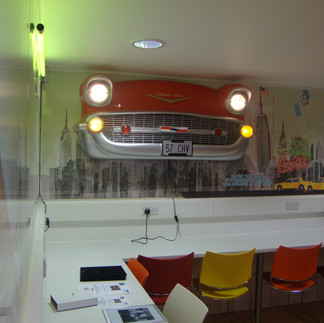
The main shared space carried one of the most revealing ideas from consultation: young people wanted an “around the world” theme because many felt they might never visit those places themselves. That led to large graphics of iconic landmarks, while keeping Sheffield at the centre of the story, giving local pride equal importance to aspiration.

Unexpected objects helped shape identity across the building. A red phone box, an American replica car fixed to the wall and other unusual features became visual anchors. These were not just decorative items, they became conversation starters and gave the centre character that young people remembered.



Commercial-grade furniture was used throughout so the space felt durable and credible, while young people also contributed directly by creating sprayed artwork onto selected surfaces, giving visible ownership to the final environment.
The project required close collaboration with Kier Group, who carried out the building works. Every design decision had to connect with practical delivery, from plug point locations and lighting positions to colour schemes and the fitting of wall graphics.
What emerged was not simply a refurbished building.
It became a youth environment shaped by consultation, imagination and design decisions that made young people feel the space belonged to them.
And when that happens, a building behaves very differently. Ideas on youth centres transformation


Comments