
Leicester Youth Offending Team
Digital Engagement Tool for Young Offenders
How can you get honest input from young people on licence when standard assessments cause resistance?
AssetPlus relies on long, form-based input, yet many young people rush it, disengage or provide surface-level answers. This leads to incomplete profiles, weaker interventions and professionals making decisions without the depth of understanding they need.

Turning assessment into engagement
Using video-game mechanics and a bold, street-level visual language, we turned assessment into a clear, engaging and navigable journey.
Each stage removes cognitive overload, builds trust and prompts self-reflection, producing deeper, more reliable information than traditional form-based approaches.
About me
Young person introduces their identity in their own way. This builds ownership, reduces defensiveness and gives practitioners personal context that is often missing from formal assessment.


Anger Management
Interactive scenarios that help young people recognise physical and emotional triggers, explore consequences and identify practical calming strategies.
The focus is on self-awareness and behaviour patterns rather than instruction.
Family tree
A visual mapping of relationships and influences.
This reveals support networks, absent figures and environmental pressures,critical for understanding risk, resilience and intervention opportunities.

Timeline tracing key life moments
Young people chart significant events in their lives, both positive and negative.
This creates a structured narrative that helps professionals identify patterns, trauma points and turning moments that shape current behaviour.

Understanding severity and real impact
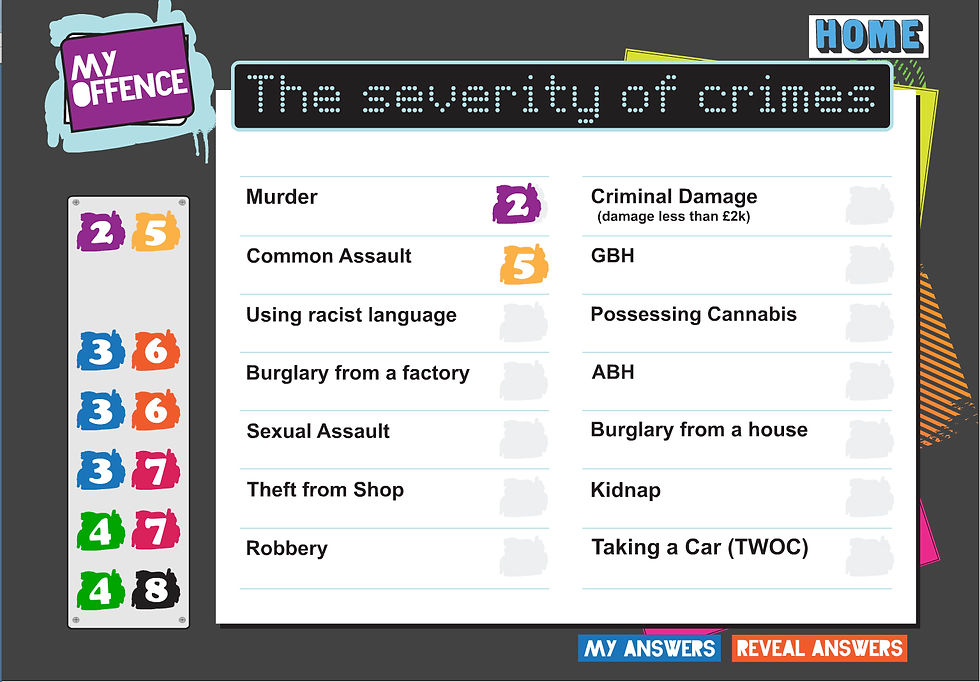
Young people score the seriousness of offences based on their own perception and then compare their answers to the official gravity scale.
The visual gap between the two creates a powerful moment of self-realisation, challenging minimisation and opening up a deeper conversation about harm, consequence and responsibility.

Changing the viewpoint
By turning the offence into a front-page story, the young person moves from being inside the moment to seeing it as the world sees it.
This creates a natural pathway into victim awareness, accountability and reflective dialogue.